Autosomal dominant Alzheimer’s disease (ADAD) is a form of genetically inherited Alzheimer’s that makes up only about 1% of Alzheimer’s disease occurrences. However, because of the extremely high rate and early age at which individuals with the gene mutations develop Alzheimer’s disease, and also because of the high heritability of the mutation, ADAD is widely studied by Alzheimer’s disease researchers.
A new study by WashU Medicine researchers and collaborators, published in Lancet Neurology, identified variants in three other genes that seem to change how Alzheimer’s disease presents in people with ADAD mutations. Pinpointing these and other genetic factors that impact Alzheimer’s disease development and progression may allow investigators to more effectively provide genetic counseling for families, design clinical trials and develop new treatments for preventing or slowing down Alzheimer’s disease in the larger population.
Previous studies had already identified three key genes — amyloid precursor protein (APP), presenilin1 (PSEN1) and presenilin2 (PSEN2) — that are associated with ADAD, as well as 279 variants in those genes that lead to Alzheimer’s disease. What is still not clear, however, is what leads to differences in disease onset and progression among individuals who have a disease-causing variant. For instance, even if a person carried an APP, PSEN1 or PSEN2 mutation, and therefore was very likely to develop early-onset Alzheimer’s, there is variability in when they might begin to show symptoms of cognitive decline, even among individuals who have the same disease-causing mutation.

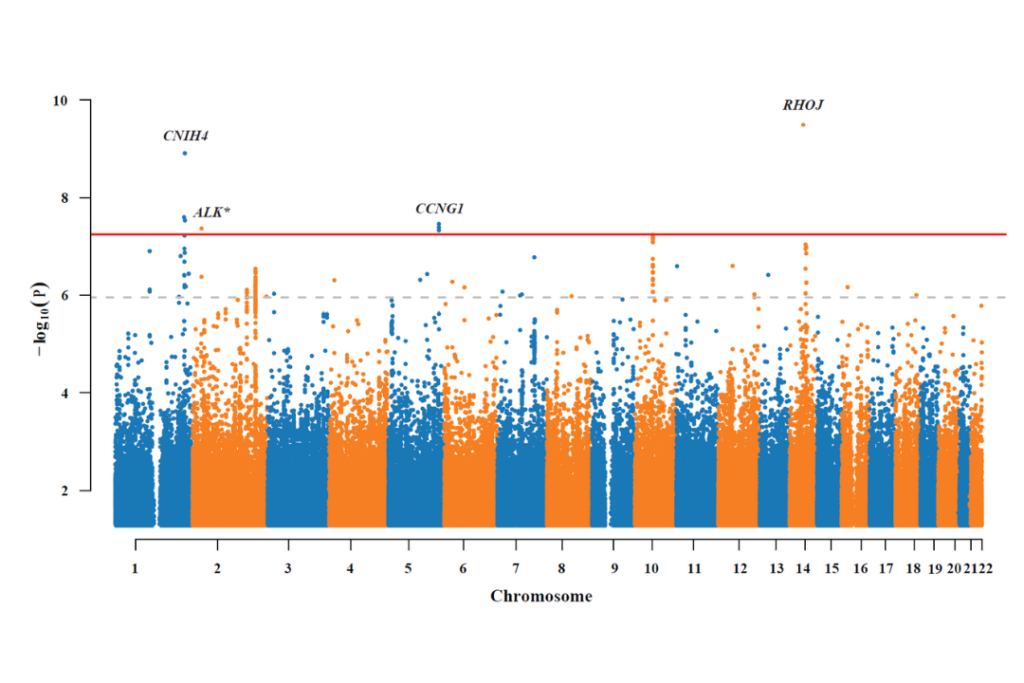
A team of researchers led by senior author Cyril P. Pottier, PhD, assistant professor of neurology and of psychiatry at WashU Medicine, analyzed genomic data from 101 carriers of ADAD gene mutations who were already showing symptoms of Alzheimer’s disease. The genetic information of these participants was compared with each other and over 5,000 individuals without a known ADAD mutation. This method allowed the study’s authors, including postdoctoral research associate and first author Maulikkumar P. Patel, PhD, to successfully identify three new genetic loci — a specific chromosomal location where a particular gene is located — that seem to act as modifiers of Alzheimer’s disease progression in individuals who carry known ADAD mutations. Of these three loci, one was associated with earlier onset of Alzheimer’s disease symptoms, while another was linked to higher levels of certain proteins, such as tau proteins, that have been linked to Alzheimer’s disease. A third locus was not linked to any clear differences in disease onset or progression but suggested a potential explanation for how ferroptosis — oxytosis, or iron-programmed cell death — might play a role in the neurodegeneration that Alzheimer’s disease patients experience.
What is particularly noteworthy about the three new genetic loci identified in this study is that variants in these three loci are present in 27% of ADAD mutation carriers, making them much more common than the extremely rare modifier variants that had previously been identified, such as the Christchurch variant. In addition, the three loci were found to be associated with higher Alzheimer’s disease risk regardless of which ADAD gene variant the individual had. These two factors make the newly discovered loci much more useful for future research and could help individuals regardless of their ADAD mutation status. “Uncovering these genetic clues brings us one step closer to personalized family guidance and next-generation therapies that could change how we approach Alzheimer’s disease,” Pottier said.
Gene variants and Alzheimer’s disease
A frequently cited example of the variability in ADAD is the Christchurch variant. A variant of the Apolipoprotein E (APOE) gene, the Christchurch variant seems to be protective against the effects of the PSEN1 ADAD gene mutation. This is thought to be because while the PSEN1 variant causes high levels of the beta-amyloid protein, which can lead to Alzheimer’s disease, the Christchurch variant prevents the formation of tau tangles, another protein that is thought to be responsible for the cognitive decline associated with Alzheimer’s disease.
In addition to the dramatic protective effects of the Christchurch variant, which is limited to a very small number of families worldwide, there are more subtle differences among ADAD carriers, chiefly in the age at onset of dementia, leading scientists to attempt to identify the genetic factors that might be associated. One investigative approach has been to look for associations between age of onset and any of the 279 disease-causing variants in the APP, PSEN1 and PSEN2 genes, but there have been no connections found to date.
Patel M, Feng W, Mckay NS, Millar PR, Liu M, Yang C, et al. Identification of genetic modifiers of autosomal dominant Alzheimer’s disease: a genome-wide association study. The Lancet Neurology. 2026 Jun 1;25(6):581–90. doi:10.1016/S1474-4422(26)00123-7