
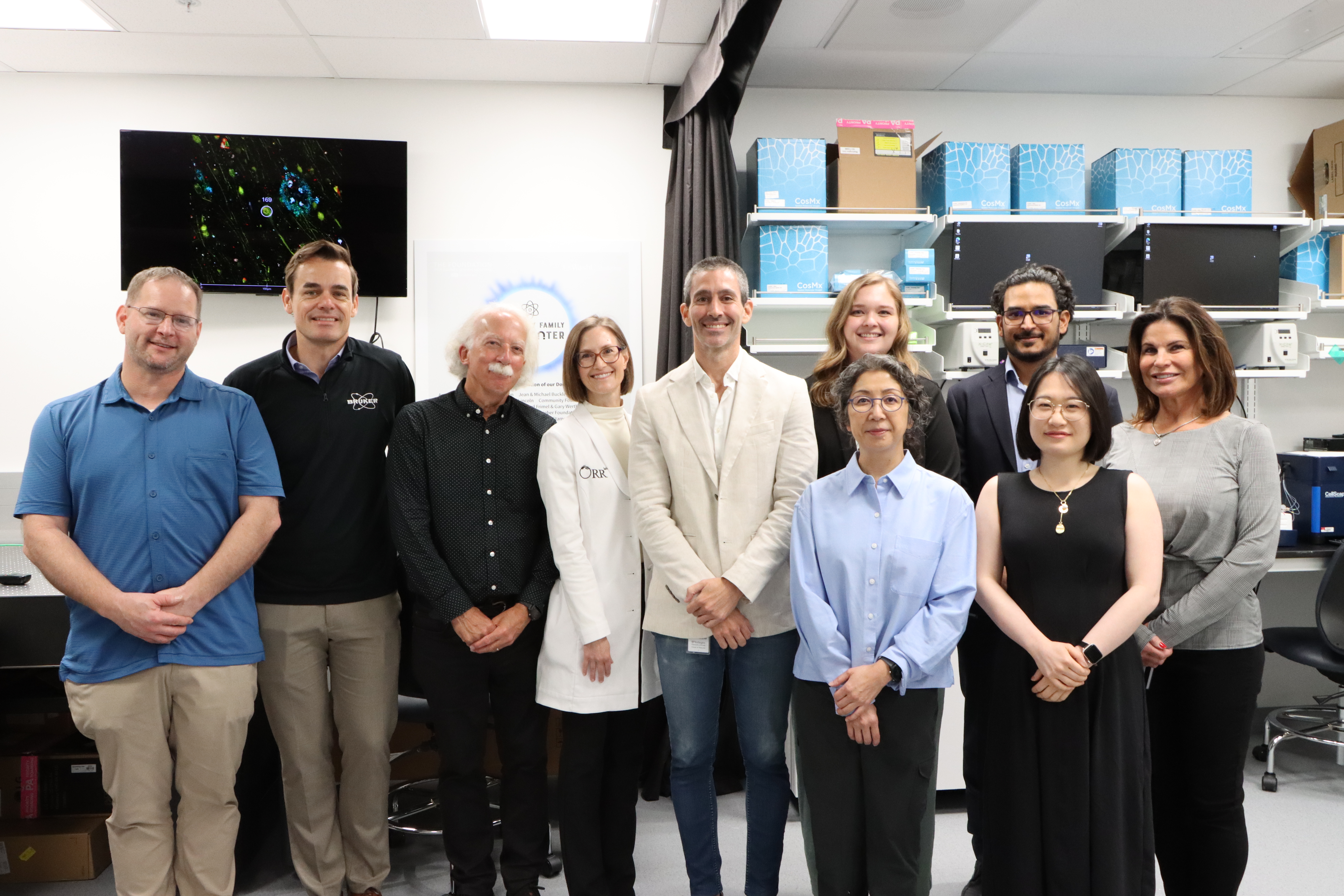
The Orr lab has been named as the first-ever Bruker Spatial Biology Center of Excellence. This distinction not only provides researchers at Washington University School of Medicine in St. Louis access to pioneering spatial omics platforms but also forges a direct partnership with Bruker Spatial Biology’s research and development team. Together, the Orr lab and Bruker Spatial Biology will push boundaries of what these technologies can achieve in an academic setting, generating first-in-field data and helping shape the tools that will define the future of spatial biology research.
“This isn’t just about being early users of new technology,” said Miranda Orr, PhD, associate professor of Neurology. “It’s about helping to shape the direction of these technologies —identifying the capabilities that academic scientists need, generating the first data of its kind and driving discoveries that will advance the field, particularly in proteomics, which is so crucial to neuroscience research.”
Bruker Spatial Biology’s platforms include those originally developed by NanoString Technologies and Canopy Biosciences. These technologies are advancing biomedical research in spatial transcriptomics, proteomics — the process of mapping proteins in cells and tissues with an emphasis on distribution, quantity and interactions — and genomics.
Orr began collaborating with NanoString Technologies nearly a decade ago because of her need to analyze proteins in single cells and their neighborhood environments in brain tissue for her research on aging and Alzheimer’s disease. The aged, damaged cells she studies are called senescent cells. They contribute to many diseases and conditions of the nervous system including Alzheimer’s disease, Parkinson’s disease, amyotrophic lateral sclerosis (ALS), stroke, multiple sclerosis (MS), traumatic brain injury (TBI), chronic pain, depression, substance use disorder and many others. Her lab was the first to identify a causal link between senescent cells and neurodegeneration due to pathogenic tau (Aging Cell, 2018) and test therapeutics to clear these cells in older adults with Alzheimer’s disease (Nature Medicine, 2023). She is currently leading a multi-site Phase 2 clinical trial to continue these efforts. For this pioneering work, she was awarded the Melvin R. Goodes Prize by the Alzheimer’s Drug Discovery Foundation in 2023, which helped support her spatial biology work, including developing protocols to apply the technologies to blood and cerebrospinal fluid from clinical trial participants. Her leadership in this area has been recognized by outlets such as National Geographic, highlighting her advances in brain aging and healthy longevity.
Her team has most recently worked with Bruker Spatial Biology to develop a spatial proteomics panel that includes over 1,100 targets that can be measured simultaneously in single cells or areas of interest in tissue samples — the most possible among single-cell spatial proteomics platforms available today. For comparison, most scientists only have access to about 30-40 proteins per sample.
“When we analyzed postmortem human brain tissue, I was amazed by the depth and clarity of the data it revealed,” Orr said. “For the first time, we had data convincingly showing that neurons with pathogenic tau are senescent. For years, we had relied on transcriptomics, but we needed protein expression data to truly strengthen our interpretation. This single experiment generated preliminary findings that multiple lab members are now pursuing, and it will take much more time to fully analyze the data and appreciate the scope of the discoveries.”
One single experiment in the Orr lab can produce up to four terabytes of data, essentially providing data on the whole transcriptome and over 1,100 proteins in every area analyzed in the tissue. With so much data to analyze, Orr plans to work with Randall Bateman, MD, and the Consortium for Biomedical Research & AI in Neurodegeneration to process and help interpret the information.
The Orr lab is drafting a manuscript about their advances in spatial proteomics and has presented the well-received data at several conferences.
Implications for aging and Alzheimer’s research
Researchers have found that the level of proteins like amyloid-beta and tau found in the brain is the best biomarker measure of Alzheimer’s symptoms and dementia. Some diagnostic blood tests for Alzheimer’s disease look at the levels of a tau protein in the blood as a reflection of the amount of toxic accumulation of proteins in the brain. Orr’s work in spatial proteomics could contribute to a more complete understanding of disease onset and progression, leading to earlier Alzheimer’s diagnosis and new treatments.
Orr, co-director of the Tracy Family Stable Isotope Labeling Quantitation (SILQ) Center, plans to use the technology available to her and her team to provide new insights into the work done on fluid biomarkers by Bateman and others at the SILQ Center, which is dedicated to discovering biomarkers of aging, Alzheimer’s disease and related disorders through novel methods. “We still don’t know where in the brain, and what cells in the brain, are responsible for producing the biomarkers measured in peripheral fluids,” Orr said. “The spatial platforms will help answer these questions.”
“We are thinking about new ways to use the instruments — new experiments, new discoveries. It’s just really exciting,” Orr said. “This is the future of neuroscience and biomedical research, and we’re honored to help shape it.”