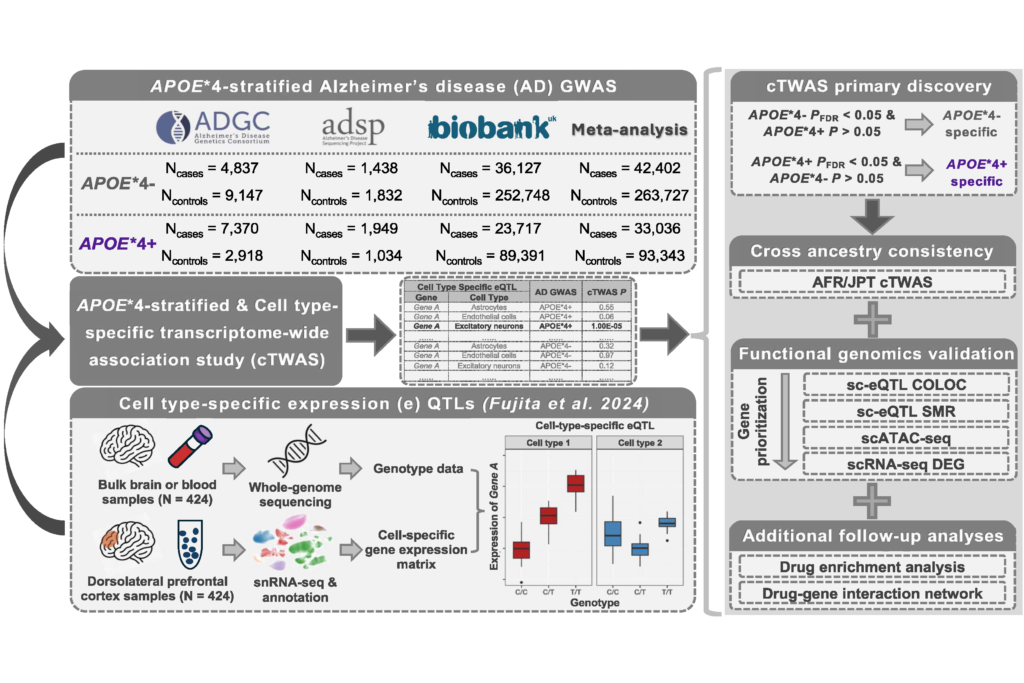
An international team of researchers led by Michael E. Belloy, PhD, assistant professor of neurology and of psychiatry at WashU Medicine, identified key genetic targets for potential Alzheimer’s disease therapeutics development. Targeting specific genes in individuals would allow researchers to take a much more precise approach to Alzheimer’s disease prevention and treatment. Their findings were published in Alzheimer’s & Dementia: The Journal of the Alzheimer’s Association.
Alzheimer’s and other related forms of dementia are an ever-growing public health concern in the 21st century. This is especially true for individuals who are at higher risk of developing Alzheimer’s because of their genes. Some forms of genetically inherited Alzheimer’s disease are known as autosomal dominant or dominantly inherited Alzheimer’s, because having even one copy of the gene mutation is enough to cause Alzheimer’s disease. This type of Alzheimer’s disease accounts for 1% of all Alzheimer’s disease occurrences. Another type of genetic Alzheimer’s is related to APOE4, a variant of the apolipoprotein E (APOE) gene, and is much more common, accounting for roughly 50% of older adults who develop Alzheimer’s disease. But unlike those with an autosomal dominant gene variant, most of whom develop Alzheimer’s disease, individuals with one or two copies of the APOE4 variant have anywhere from a 4-fold to 12-fold chance of developing Alzheimer’s compared to those without any copies of APOE4. If scientists can understand what protects some carriers of the APOE4 from Alzheimer’s disease, they may be able to apply this understanding to lower the rate of Alzheimer’s among APOE4 carriers, and the rate of Alzheimer’s in the human population overall.
This was precisely the goal of Belloy and his team. “One of the most exciting aspects was seeing that there seems to be a substantial number of genes that have potential to reduce the impact of APOE4 on Alzheimer’s disease,” said Belloy. “That’s in contrast to prior genetics work that has often studied or identified only one such gene at a time.”
Similar previous studies were based on smaller data sets and often remained at the level of identifying individual genes associated with Alzheimer’s disease. This new study by Belloy and colleagues analyzed the genomes of nearly 450,000 individuals of European, African and Japanese ancestries, using pooled data from multiple genetics databases and public repositories, and included individuals with and without Alzheimer’s disease diagnoses, and with and without the APOE4 gene. After a rigorous statistical analysis process that had multiple built-in safeguards against false associations and statistical bias, the study’s authors, including first author Youjie Zeng, MD, PhD, postdoctoral research associate in the Belloy lab, identified 44 key genes that were associated with specific types of cells — and therefore could help explain the mechanisms by which Alzheimer’s develops — as well as specific drug candidates to target those genes.

Among the 44 identified genes — verified using a brain cell-specific multi-omics analysis of DNA, RNA, and epigenetic data — the 11 genes associated with changes in Alzheimer’s disease risk in APOE4 carriers, especially TNS3 and CISD1, may be of particular interest for future research, according to the study’s authors. The authors also pointed to the large proportion of APOE4-associated genes that were linked to a type of cell called oligodendrocytes, which are responsible for producing myelin. Myelin in turn enables efficient communication between neurons. This link suggests that treatments specifically targeting genes related to oligodendrocytes in APOE4-positive individuals could help preserve myelination (and therefore brain function) and protect against the harmful effects of Alzheimer’s disease.
“In the long term, I believe our findings could help move the field toward a more personalized approach to Alzheimer’s disease,” Belloy said. “Rather than treating all patients as though they have the same disease, we may be able to identify which biological mechanisms are driving risk in those with or without APOE4 and tailor prevention or treatment strategies accordingly. It feels like we are really working toward precision medicine for Alzheimer’s disease.”
Zeng Y, Cook N, Yang C, Sivasankaran SK, Fujita M, Gardell ZA, Le Guen Y, Shigemizu D, Ozaki K, Morizono T, Hara N, Miyashita A, Ikeuchi T, Pottier C, Cruchaga C, Napolioni V, Corces MR, Menon V, Greicius MD, Belloy ME. APOE*4 risk-modifying genes and drug targets in Alzheimer’s disease through cell-type-specific genomic analyses. Alzheimers Dement. 2026 Jun;22(6):e71552. doi: 10.1002/alz.71552. PMID: 42328930; PMCID: PMC13285033.