Jump to…
“In my time at WashU Medicine, I saw every possible rare, unusual case imaginable. It felt like every week someone would say, ‘Hey we should write that up’ after another unique case came in.”
Elizabeth Perelstein, MD, house staff ’20
Assistant Professor, Brown University
Exceptional training
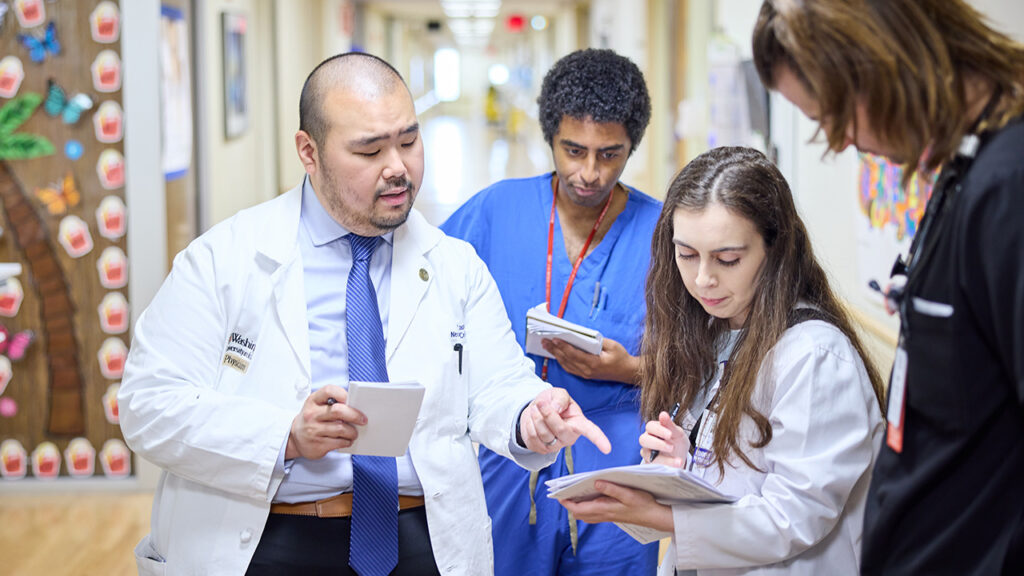
As a resident at WashU Medicine, you’ll join a collaborative community of neuroscience physicians and scientists.
- Our seamlessly integrated categorical program allows you to obtain a mastery of internal medicine during your intern year interspersed with rotations on inpatient psychiatry and the emergency department as well as on the neurology wards, learning how to read EEG in our basics of EMU introductory rotation and exploring outpatient neurology subspecialties, all before you even start your PGY-2 year.
- In the clinic, you’ll treat everything — and a lot of it. We draw a large patient population with conditions from the common to the rare and complex. Learn about our clinical environment
- Gain clinical expertise with confidence. With our supervised, graded independence, you’ll have decision-making responsibility with the right amount of support and guidance.
- Learn from world-renowned faculty in every neurology subspecialty and all related specialities.
- Join an immense neuroscience community, with 170+ faculty in neurology alone.
- 35 weeks of elective time allows you to pursue your interests in the clinic, hospital, research laboratory and even internationally!
- Choose from fellowships in every subspecialty, if you plan on further training after residency.
Program tracks
Master clinician track
Developing diagnostic mastery through immersive clinical training
Providing residents with intensive exposure to diverse neurological subspecialties, the master clinician track fosters the development of advanced clinical acumen and procedural expertise. Emphasizing diagnostic reasoning, complex case management and the interplay between neurologic and systemic disease, this individualized training pathway equips graduates for a wide range of career trajectories — from general community practice to academic subspecialization.
Training focus
diagnostic skills • use of cutting-edge technology • in-depth understanding of neuropathology and evidence-based medicine
Physician-scientist track
Opportunities for research excellence through the physician-scientist track
Offering a unique integration of clinical training and scientific inquiry, the physician-scientist track provides residents with early and sustained opportunities to engage in research. With dedicated time beginning in the intern year, participants work alongside internationally recognized mentors in neurology to pursue bench, translational or clinical research. Supported by a strong track record of R25 funding and the resources of a top NIH-funded department, this track fosters the development of future leaders in neuroscience research.
Training focus
R25 proposal mentorship • field-changing research opportunities • opportunity to obtain Masters of Science in Clinical Investigation
Clinician educator track
Developing future leaders in academic neurology education
Providing a structured and personalized approach to professional development, the resident clinical educator track equips neurology residents with the essential skills and experiences needed for a successful career in medical education. Through close collaboration with departmental and institutional education leaders, residents engage in a longitudinal curriculum that emphasizes curriculum design, mentorship, feedback delivery and effective teaching strategies. This pathway ensures that graduates emerge as confident, capable educators ready to contribute meaningfully to academic medicine.
Training focus
didactic skills • assessment • feedback delivery • mentorship and coaching • curriculum design and management • identification and use of education theory • consumption and production of education scholarship
Supportive approach
- Mentoring is a priority. Our 170+ faculty are passionate about teaching and committed to your success.
- Diversity, equity and inclusion are at our very core. Every mission of our department is guided by these values.
- We have a culture of family, in which fellow residents become your lifelong friends and faculty are here to support you.
Are you ready?
Learn more about our application process.