$4.5 million supports pathbreaking neuroimmunology research (Links to an external site)

A $4.5 million grant from the Carol and Gene Ludwig Family Foundation will support innovative projects led by WashU Medicine’s neuroimmunology experts, including (from left to right) David M. Holtzman, MD; Jonathan Kipnis, PhD; and Marco Colonna, MD, in addition to other faculty members through a seed grant program.

Washington University School of Medicine in St. Louis has received a three-year, $4.5 million grant from the Carol and Gene Ludwig Family Foundation, aimed at advancing research on neuroimmunology and neurodegeneration with the ultimate goal of developing new treatments for Alzheimer’s disease. Administered by WashU Medicine’s Brain Immunology & Glia (BIG) Center, the Carol and […]

Electrochemical field key to how dementia precursors ‘break bad’ (Links to an external site)

Amyloid beta peptides start out as helpful scaffolding, but they can turn toxic with the production of reactive oxygen molecules. Researchers at Washington University in St. Louis have found a new way to interrupt the toxic spread of these peptides. (Image: Michael W. Chen and Wenjing Li)

Protein accumulations do important work in the human body, but something can go wrong and proliferate in those aggregates, resulting in neurodegeneration and diseases such as Parkinson’s and Alzheimer’s. One such assembly, amyloid beta peptide, is synonymous with dementia, but researchers were not certain how these peptide assemblies “break bad” and what really causes them […]

Novel Gene Therapy Clinical Trial Targets Rett Syndrome

Gloved hands hold syringe to glass vial

Washington University School of Medicine in St. Louis is one of only ten sites in the world participating in a pioneering clinical trial evaluating TSHA-102, an investigational gene therapy for the treatment of Rett syndrome, a severe neurodevelopmental disorder primarily affecting girls. The REVEAL Phase 1/2 clinical trial represents a significant advancement in the quest […]

Study highlights barriers to genetic testing for Black children (Links to an external site)

A recent study by WashU Medicine researchers found Black children were about half as likely as white children to obtain genetic testing ordered by their neurologists. The results are already changing practice at WashU Medicine’s pediatric neurology clinic, where a genetic counselor has been embedded to help address some of the access challenges uncovered by the study.

Studies have shown that Black children with serious illnesses are less likely than white children to obtain crucial genetic testing necessary to guide treatment decisions, but the reasons for this disparity have not been fully understood. A new study from Washington University School of Medicine in St. Louis focused on children with neurological conditions finds […]

Next-gen Alzheimer’s drugs extend independent living by months (Links to an external site)

An Alzheimer’s patient with very mild symptoms who undergoes treatment with one of the new, next-generation therapies could expect to gain eight or 10 months living independently, according to a study by researchers at WashU Medicine. The new analysis interprets the benefits of the drugs in a way that is meaningful to patients and families, to help them make informed decisions about treatment.

In the past two years, the Food and Drug Administration has approved two novel Alzheimer’s therapies, based on data from clinical trials showing that both drugs slowed the progression of the disease. But while the approvals of lecanemab and donanemab, both antibody therapies that clear plaque-causing amyloid proteins from the brain, were greeted with enthusiasm […]

Patient defies genetic fate to avoid Alzheimer’s (Links to an external site)

Doug Whitney, who lives near Seattle, Wash., inherited a mutation that has caused many family members to develop Alzheimer's disease at about age 50, yet he shows no sign of the illness at age 75. His case is the subject of a new study by WashU Medicine researchers that aims to identify potential routes to preventing or treating Alzheimer's based on Whitney's exceptional resilience to the disease.

Remarkably, Doug Whitney, 75, has escaped genetic destiny. Like many members of his family, Whitney inherited a rare genetic mutation that all but guarantees he would develop early-onset Alzheimer’s disease. But Whitney, whose relatives first showed symptoms of cognitive decline in their early 50s, remains mentally sharp with no signs of the devastating disease, and […]

International Alzheimer’s prevention trial in young adults begins (Links to an external site)

Primary Prevention trial participant Hannah Richardson, 24, undergoes a clinical exam given by WashU Medicine neurologist Nupur Ghoshal, MD, PhD. The international trial, led by WashU Medicine, aims to determine whether stopping the early molecular changes that lead to symptomatic Alzheimer’s disease can prevent the disease from ever taking hold.

The first participants in an international clinical trial aimed at preventing Alzheimer’s disease in young adults at high risk of the disease have been enrolled. The trial, led by Washington University School of Medicine in St. Louis, aims to determine whether stopping the early molecular changes that lead to symptomatic Alzheimer’s disease can prevent the […]

Brains of people with sickle cell disease appear older (Links to an external site)

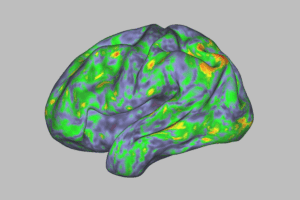
A new study led by WashU Medicine researchers has found older-looking brains in adults with sickle cell disease, helping to explain the cognitive challenges experienced by such individuals. A brain image from a healthy individual (left) shows a larger brain with more white matter compared with a brain image from a patient with sickle cell disease (right). Healthy individuals experiencing economic deprivation also had more-aged appearing brains.

Individuals with sickle cell disease – a chronic illness where misshapen, sticky blood cells clump together, reducing oxygen delivery to organs – are at a higher risk for stroke and resulting cognitive disability. But even in the absence of stroke, many such patients struggle with remembering, focusing, learning and problem solving, among other cognitive problems, […]

New Qalsody Results Bring Hope for Recovery of Lost Function and More Time (Links to an external site)

For decades, the general consensus among neurologists and neuroscientists has been that ALS treatments would only be able to slow down or stop further progression of the disease. Function that had already been lost would probably not be recovered. But now, evidence is emerging that not only is functional improvement possible, it’s happening for some people […]