New drug targets for Alzheimer’s identified from cerebrospinal fluid (Links to an external site)
Washington University School of Medicine in St. Louis

A multitude of genes have been linked to the development of Alzheimer’s disease. Specifically how those genes might influence the progression of neurodegeneration remains something of a black box though, in part because of the challenges of examining in molecular detail the brain of a living patient. Using cerebrospinal fluid (CSF) collected from living patients, […]

WashU Medicine celebrates first R01 recipients (Links to an external site)

Washington University School of Medicine in St. Louis celebrated rising investigators at the First R01 Celebration, marking a significant milestone for scientists embarking on their independent research careers. The event honored recipients of their first R01 research grants from the National Institutes of Health (NIH). The research grants represent the NIH’s recognition of investigators’ rigorous, […]

Memory Loss Isn’t the Only Sign of Dementia (Links to an external site)

Running red lights. Falling for scams. Shutting out friends. Memory loss is the most well-known symptom of dementia, particularly Alzheimer’s disease. But experts say there are other warning signs that can signal early brain changes — ones that are especially important for types of dementia where forgetfulness is not the primary symptom.

Novel immunotherapy improves recovery from spinal cord injury (Links to an external site)

Washington University School of Medicine in St. Louis

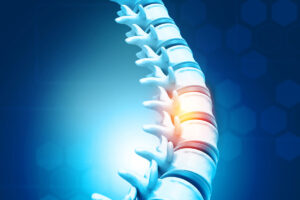
Severe injuries to the spinal cord damage nerve cells, disrupt communication with the brain and rest of the body, and lead to lasting disabilities for millions of people worldwide. The injury itself accounts for only a fraction of the overall damage inflicted on the spinal cord, tissue that runs from the brain stem to the […]

Adding anti-clotting drugs to stroke care ineffective, clinical trial finds (Links to an external site)

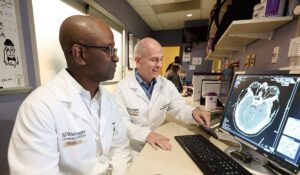
Opeolu Adeoye, MD, and Peter Panagos, MD, (right) both professors of emergency medicine at Washington University School of Medicine in St. Louis, analyze a brain scan for stroke damage. Adeoye led a national clinical trial that found that two anti-coagulant medications are ineffective at improving post-treatment outcomes for stroke patients. (Photo: Tim Miller)

Stroke patients who survive a blood clot in the brain’s blood vessels are prone to developing new blockages during their recovery periods, even if they receive vessel-clearing interventions. In an effort to avoid further clots, doctors at 57 sites around the U.S. tested a possible solution: the addition of anti-coagulant drugs to medicine that dissolves […]

Multiple sclerosis appears to protect against Alzheimer’s disease (Links to an external site)

A collaborative investigation among WashU Medicine experts in Alzheimer’s disease and multiple sclerosis (MS) finds evidence that MS patients are less likely to have amyloid plaques, a hallmark of Alzheimer's disease, than adults without MS.

People with multiple sclerosis (MS) are far less likely than those without the condition to have the molecular hallmarks of Alzheimer’s disease, according to new research from Washington University School of Medicine in St. Louis. The discovery suggests a new avenue of research through which to seek Alzheimer’s treatments, said Matthew Brier, MD, PhD, an assistant […]

Blood tests for Alzheimer’s may be coming to your doctor’s office. Here’s what to know (Links to an external site)

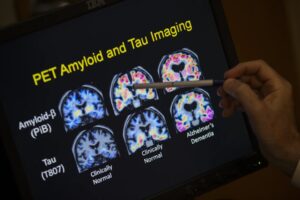
FILE - A doctor points to PET scan results that are part of a study on Alzheimer’s disease at Georgetown University Hospital, on Tuesday, May 19, 2015, in Washington. (AP Photo/Evan Vucci, File)

New blood tests could help doctors diagnose Alzheimer’s disease faster and more accurately, researchers reported Sunday – but some appear to work far better than others. It’s tricky to tell if memory problems are caused by Alzheimer’s. That requires confirming one of the disease’s hallmark signs — buildup of a sticky protein called beta-amyloid — with a hard-to-get brain […]

Aging-related genomic culprit found in Alzheimer’s disease (Links to an external site)

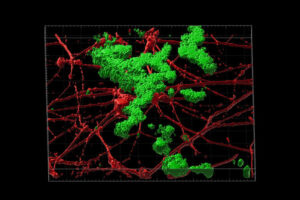
Researchers at Washington University School of Medicine in St. Louis have developed a way to study aged neurons in the lab without a brain biopsy, allowing them to accurately model the effects of aging in the development of late-onset Alzheimer's disease. Shown is a 3D reconstruction of amyloid beta plaque deposition (green) between neurons (red) grown in the lab. These neurons were transformed from human skin cells taken from patients with late-onset Alzheimer's disease.

Researchers at Washington University School of Medicine in St. Louis have developed a way to capture the effects of aging in the development of Alzheimer’s disease. They have devised a method to study aged neurons in the lab without a brain biopsy, an advancement that could contribute to a better understanding of the disease and […]

Accuracy of diagnostic blood tests for Alzheimer’s disease varies (Links to an external site)

A head-to-head comparison of six commercially available blood tests for Alzheimer’s disease led by researchers at Washington University School of Medicine in St. Louis reveals that two are accurate enough to replace brain scans and spinal taps in some patients with cognitive impairments.

Neurologists diagnose cognitive impairment with a clinical exam of memory and thinking skills. To determine whether Alzheimer’s disease is the cause of the cognitive impairment, evidence of the specific brain changes that characterize Alzheimer’s must be obtained, typically via a brain scan or spinal tap. Identifying people whose cognitive symptoms are due to Alzheimer’s disease […]