$4 million grant expands major study to find Alzheimer’s prevention treatments
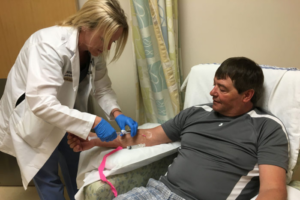
Dean DeMoe, a participant in the Dominantly Inherited Alzheimer Network Trials Unit (DIAN-TU) study at Washington University, receives AV1451 — a radiopharmaceutical — from imaging technologist Holly Karsch. AV1451 binds to tau protein in the brain. (Photo: Judy Martin Finch)

Investigators will accelerate drug testing, develop new diagnostic measures. Washington University School of Medicine in St. Louis has received a $4.3 million award from the Alzheimer’s Association to expand a major international clinical trial evaluating whether drugs can prevent Alzheimer’s disease in patients genetically predisposed to develop the devastating disease at a young age. The […]

New insight into role of amyloid beta in Alzheimer’s disease

A new technique for measuring levels in the brain of amyloid beta, a key protein associated with Alzheimer’s disease, would help scientists design treatments to limit its accumulation. Carla Yuede, PhD, and John Cirrito, PhD, look at the tiny probe they used to measure the damaging protein. Credit: Robert Boston

New Alzheimer’s disease research details a technique that speedily measures levels in the brain of a damaging protein fragment, and insight into why mutations in a specific gene increase the risk of developing the disease. Both studies, from researchers at Washington University School of Medicine in St. Louis, are available online in the Journal of […]

Brain imaging links Alzheimer’s decline to tau protein

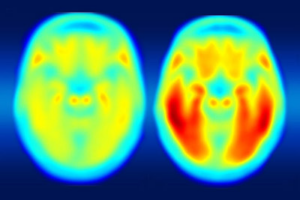
A study using a new PET imaging agent shows that measures of tau protein in the brain more closely track cognitive decline due to Alzheimer’s disease compared with long-studied measures of amyloid beta. More red color indicates more tau protein. The image on the left shows the average tau accumulation in the brains of cognitively normal people, averaged over many individuals. The image on the right shows the average amount of tau buildup in the brains of multiple people with mild Alzheimer’s symptoms. Scanning multiple individuals shows that the intensity of tau deposits correlates with the severity of cognitive dysfunction. (Image: Matthew R. Brier)

Tau is better marker of progression to Alzheimer’s disease than amyloid beta A buildup of plaque and dysfunctional proteins in the brain are hallmarks of Alzheimer’s disease. While much Alzheimer’s research has focused on accumulation of the protein amyloid beta, researchers have begun to pay closer attention to another protein, tau, long associated with this […]

Problems finding your way around may be earliest sign of Alzheimer’s disease, study suggests

Participants in this Alzheimer’s disease study used a joystick to navigate a virtual maze and locate landmarks, such as this bookcase. (Image courtesy of Denise Head)

Navigation skill test could diagnose brain changes long before memory fails Long before Alzheimer’s disease can be diagnosed clinically, increasing difficulties building cognitive maps of new surroundings may herald the eventual clinical onset of the disorder, finds new research from Washington University in St. Louis.“These findings suggest that navigational tasks designed to assess a cognitive […]

Alzheimer’s drug test disappoints, but some see benefit

891 patients with mild or moderate Alzheimer’s disease participated in study By Susan Scutti CNNPOSTED: 8:27 AM PDT July 27, 2016 UPDATED: 10:47 AM PDT July 27, 2016Health, medical research(CNN) –The latest round of testing for a new Alzheimer’s drug didn’t produce the results researchers hoped for, but a small number of patients did see […]

Brain’s ability to dispose of key Alzheimer’s protein drops dramatically with age

The greatest risk factor for Alzheimer’s disease is advancing age. After 65, the risk doubles every five years, and 40 percent or more of people 85 and older are estimated to be living with the devastating condition. Researchers at Washington University School of Medicine in St. Louis have identified some of the key changes in […]