Alzheimer’s gene poses both risk — and benefits (Links to an external site)

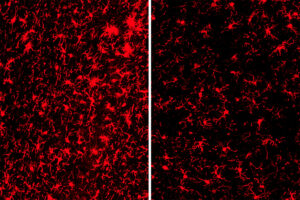
Immune cells are more activated (red) in the brains of mice with the gene TREM2 (left) than in those without the gene (right). A new study shows that having a working copy of the gene TREM2 can reduce risk of Alzheimer’s disease under certain conditions but worsen disease in others.

Scientists drilling down to the molecular roots of Alzheimer’s disease have encountered a good news/bad news scenario. A major player is a gene called TREM2, mutations of which can substantially raise a person’s risk of the disease. The bad news is that in the early stages of the disease, high-risk TREM2 variants can hobble the immune system’s ability to […]

Miller named Clayson Professor of Neurology

Timothy M. Miller, MD, PhD, a leading researcher in the neurodegenerative disorder amyotrophic lateral sclerosis (ALS), has been named the David Clayson Professor of Neurology at Washington University School of Medicine in St. Louis. The professorship was established in 2001 through a bequest from David Clayson, PhD, to support innovative research into treatments for ALS, the […]

Longer-lived imaging agents could hasten Alzheimer’s research

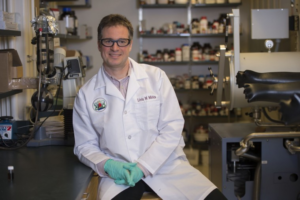
Mirica in his lab at Washington University in St. Louis. (Photo: Joe Angeles/Washington University)

In the past few years, despite the best efforts of scientists and medical researchers, drug after drug designed to slow or stop the progression of Alzheimer’s disease has failed in clinical trials. Some had no effect on the progression of the disease, others made patients’ symptoms worse and yet others produced results so equivocal it […]

Wong named Green Professor of Pediatric Neurology

Michael Wong, MD, PhD, has been named the Allen P. and Josephine B. Green Professor of Pediatric Neurology at Washington University School of Medicine in St. Louis. Wong sees patients with pediatric epilepsy at St. Louis Children’s Hospital and specializes in basic research into the origins of the illness. Pediatric epilepsy can be caused by genetic mutations and brain […]

Scientists Aim For Better, Cheaper Tests For Alzheimer’s (Links to an external site)

Finding some change in the blood of an Alzheimer's patient that accurately reflects the damaging changes in the brain has been tough. utah778//iStockphoto/Getty Images

Efforts to develop a treatment that stalls the memory-robbing devastation of Alzheimer’s disease have so far been unsuccessful, but scientists are making strides in another important area: the development of better tests to tell who has the condition. Their aim is to develop more accurate, cheaper and less invasive tests to detect the biological markers […]

Blood test detects Alzheimer’s plaques building up in brain (Links to an external site)

Early screening Deyan Georgiev / EyeEm / Getty

A blood test can detect whether plaques of beta-amyloid are building up in a person’s brain – a sign that they may develop Alzheimer’s disease. People with Alzheimer’s disease tend to have sticky clumps of beta-amyloid in their brains, although the part these plaques play in the condition is unclear. Until now, the only way […]

Blood test IDs key Alzheimer’s marker (Links to an external site)

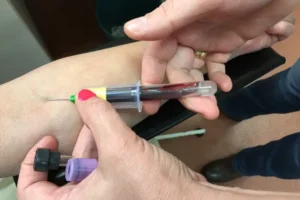
A study led by researchers at Washington University School of Medicine in St. Louis suggests that measures of amyloid beta in the blood have the potential to help identify people with altered levels of amyloid beta in their brains or cerebrospinal fluid. Ideally, a blood-based screening test would identify people who have started down the path toward Alzheimer’s years before they could be diagnosed based on symptoms. (Getty Images)

Decades before people with Alzheimer’s disease develop memory loss and confusion, their brains become dotted with plaques made of a sticky protein – called amyloid beta – that is thought to contribute to the disease and its progression. Currently, the only way to detect amyloid beta in the brain is via PET scanning, which is […]