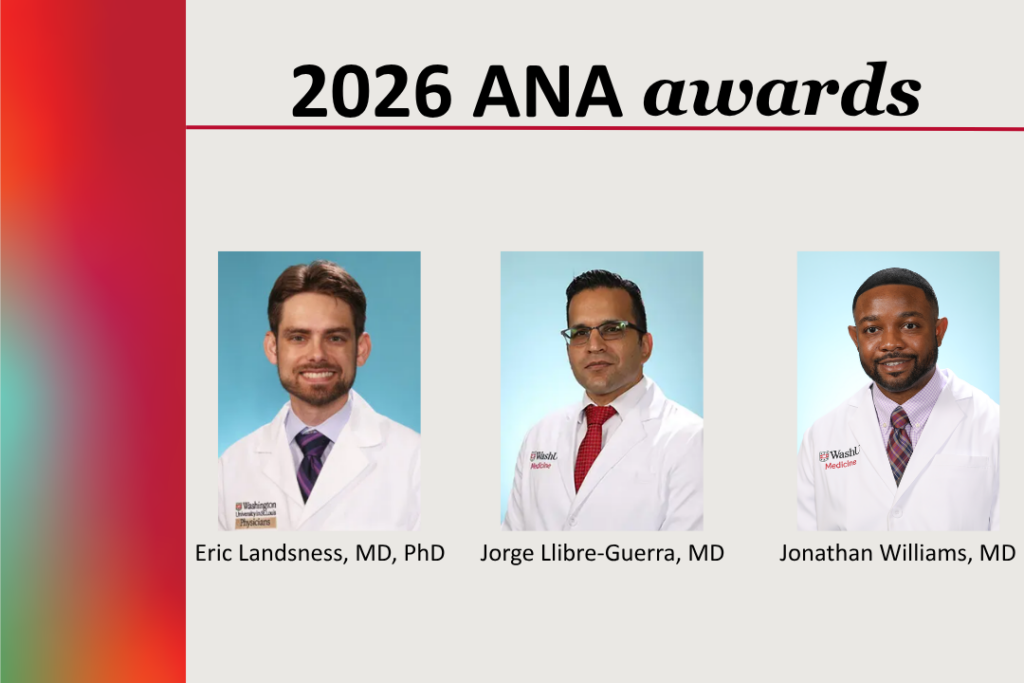
Three WashU Medicine Neurology faculty members have been selected to receive American Neurological Association (ANA) awards. Founded in 1874, the ANA is a professional society for academic neurologists and neuroscientists dedicated to understanding and treating diseases of the nervous system.
Eric C. Landsness, MD, PhD, assistant professor of neurology, will receive the ANA Rising Star Award, which recognizes an early career physician-scientist or researcher who has contributed significantly to the field of neurology through a body of research that is considered inspired, meritorious and significant, and has the potential to have a major impact on the field. As winner of the Rising Star Award, Landsness, who serves as assistant executive director of the Consortium for Biomedical Research and AI in Neurodegeneration (C-BRAIN), will give a special presentation during the 2026 ANA Annual Meeting in San Diego.
Jorge J. Llibre-Guerra, MD, assistant professor of neurology, will receive the ANA IDEAS Early Career Member Award, recognizing him as an outstanding early career physician-scientist and researcher who, through his outreach, mentoring, leadership, research and program-building, has demonstrated a commitment to addressing health-related disparities. He will be matched with a mentor who is a leader in the field and will also be given opportunities to engage with ANA committees and leadership. “I am deeply honored to receive the ANA IDEAS Early Career Member Award,” said Llibre-Guerra, who serves as Clinical Core Leader of the WashU Medicine Dominantly Inherited Alzheimer Network (DIAN) Trials Unit. “This recognition reinforces my commitment to advancing dementia research and care by improving early diagnosis, strengthening access, and expanding participation in prevention-focused clinical research.”
Jonathan P. Williams, MD, assistant professor of neurology, will receive the ANA–Persyst Professional Development Award, acknowledging an early career academic neurologist or neuroscientist specializing in the field of epilepsy. Awardees are presented with an $11,500 award for professional development activities. Williams will use the funds to build collaborations with leading epilepsy researchers in health services, health equity and community engagement and build on the momentum from the STL CARE (Community-based Advocacy to Reduce Epilepsy-related harm through Education) initiative to develop data-driven, scalable solutions to gaps in epilepsy care and translate research findings into meaningful clinical and community impact.
All award winners will be presented with their awards later this year at the 151st ANA Annual Meeting.