Joyce Romine
Streamline Communications
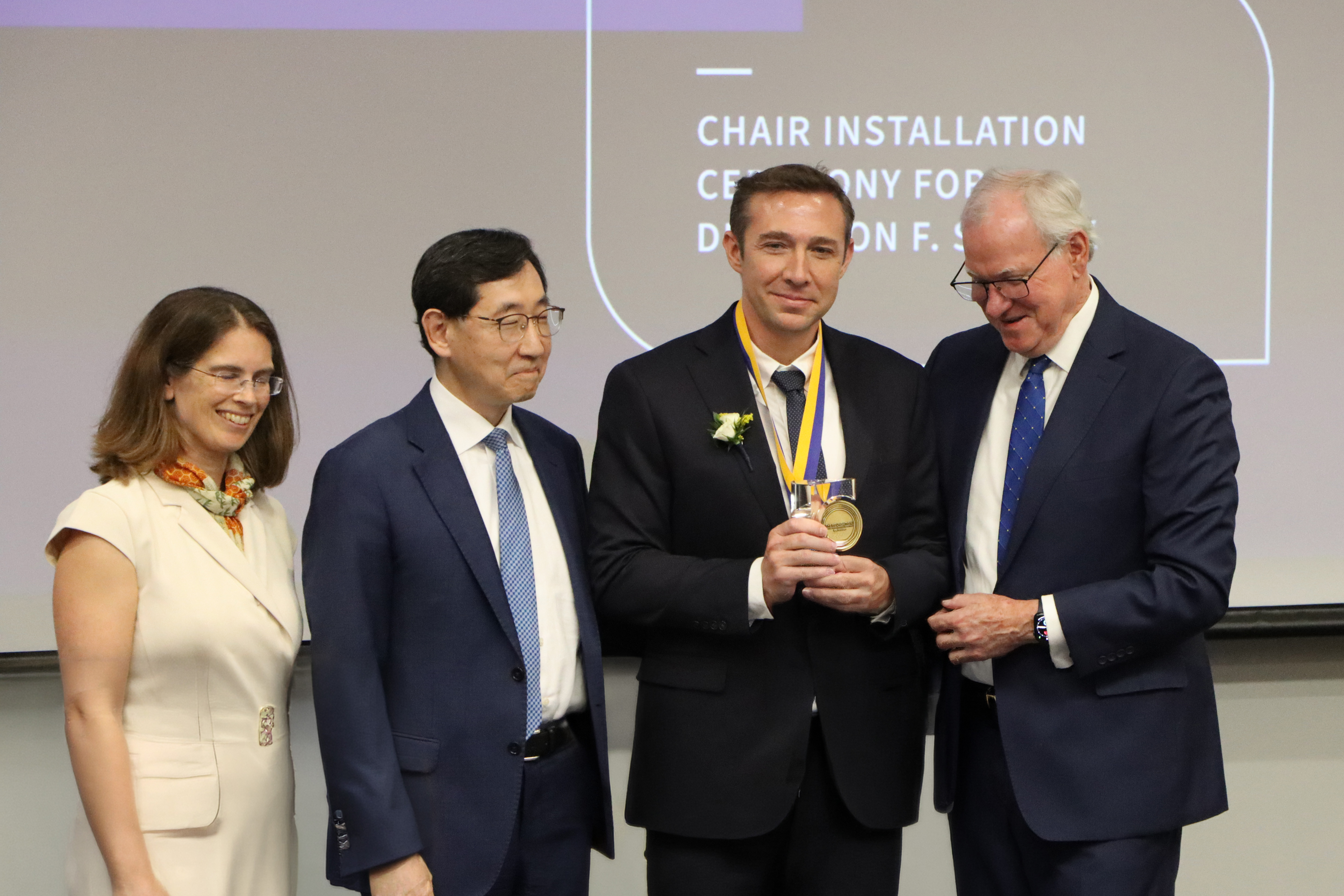
A new era is beginning in epilepsy care with the installation of WashU Medicine neurologist Aaron Struck, MD, as the inaugural Endowed Chair in Epilepsy at Barnes-Jewish Hospital. The chair was created to advance research and clinical care for patients with seizure and epilepsy.
Struck joined the WashU Medicine faculty in July 2025 as head of the adult epilepsy section to treat patients at Barnes-Jewish Hospital. His clinical and research interests include surgical treatment of idiopathic generalized epilepsy, EEG and neuroimaging, molecular imaging, and data science.
Endowed chairs are among the highest honors physicians and scientists can receive. Struck was chosen as the new chair in recognition of his outstanding clinical, scientific and administrative achievements and contributions that have benefited patients, trainees and colleagues.
The Endowed Chair in Epilepsy was established through the generosity of donors, including an estate gift from Dennis McCowan and a bequest from the John T. Loire Trust, through The Foundation for Barnes-Jewish Hospital.
Creating a pathway for achievements
“This endowed chair played a key role in recruiting Dr. Struck to lead the epilepsy program and build on the foundation of its success. Advancing medicine requires recruiting and retaining the best and brightest research scientists and physicians in specialty areas, including epilepsy.”
Katherine Henderson, MD
Vice President and Chief Medical Officer, Barnes-Jewish Hospital
Struck is dedicated to empowering patients with drug-resistant epilepsy through a personalized approach, recognizing every patient with epilepsy is unique. He champions advanced surgical strategies, including neuromodulation, to reduce seizures and improve quality of life while minimizing risks and recovery time.
Struck is also committed to partnering with St. Louis neurologists and surgeons to streamline referrals for epilepsy surgery evaluation.
Leading a national epilepsy center of excellence
About one-third of all epilepsy patients in the St. Louis region are seen at Barnes-Jewish Hospital. The hospital is recognized as a national Epilepsy Center of Excellence, as well as a Level 4 Epilepsy Center demonstrating the hospital meets the highest standards to treat the most difficult cases of epilepsy. At the time of recognition, Barnes-Jewish was one of only three epilepsy centers in the nation to receive specific Joint Commission on Accreditation of Healthcare Organizations (JCAHO) certification for epilepsy treatment.
As a leader in epilepsy treatment, WashU Medicine physicians and Barnes-Jewish Hospital were among the first in the country to use brain surgery consistently to treat patients with seizure disorders who were unresponsive to medications.
“Dr. Struck’s skills combining technology and research along with his compassionate approach to patient care make him the ideal leader to further advance our adult epilepsy program through this inaugural Endowed Chair in Epilepsy. Dr. Struck is harnessing the power of AI to enhance research and patient care in ways we never imagined ten years ago.”
Jin-Moo Lee, MD, PhD
Head of the Department of Neurology, WashU Medicine
Advancing epilepsy research through imaging and AI
Dr. Struck’s lab uses advanced neuroimaging and electrophysiology techniques — magnetic resonance imaging (MRI), positron emission tomography (PET) and electroencephalography (EEG) — to investigate the pathological drivers of epilepsy in neurology and neurocritical care.
“We aim to improve clinical care for epilepsy through machine learning, artificial intelligence, and imaging-based approaches,” Struck says. “Our ultimate goal is to understand how drug-resistant epilepsy develops and identify neurological markers that predict its progression.”
Collaborating to improve patient care
Endowed chairs are critical in academic medicine to provide permanent, reliable funding that fuels innovation and discovery, improves the standard of care and saves lives. The Endowed Chair in Epilepsy will provide funding support to advance research and clinical care for patients with seizure and epilepsy.
The Endowed Chair in Epilepsy will benefit from the strong collaboration between Barnes-Jewish Hospital and WashU Medicine to push the frontiers of medicine.
“Working collaboratively and aligning our strengths allows us to make life-changing discoveries and deliver exceptional clinical care to benefit the health of our patients and the community. With Dr. Struck’s leadership and expertise, supported by this newly created chair, we have the opportunity to advance research and maximize technology more than ever to improve patient care in epilepsy.”
Renée Shellhaas, MD, MS
Senior Associate Dean for Faculty Promotions and Career Development, WashU Medicine
Building on successes
Struck came from the University of Wisconsin-Madison, where he was medical director and section head of epilepsy and neurophysiology. He also served as director of the fellowship programs in epilepsy and clinical neurophysiology, in addition to directing the EEG lab and his own lab, the University of Wisconsin Lab for Data Science in Epilepsy and Critical Illness, which used EEG, neuroimaging and clinical data to understand the neurophysiology of epilepsy and critical illness. In 2024, he was appointed chair of epilepsy and neuromonitoring research for the University of Wisconsin Medical Foundation.
Beyond his university appointments, Struck has held leadership roles with the Wisconsin Neurological Society and with the Critical Care EEG Monitoring Research Consortium, which he chaired from 2023 to 2025. He has been a member of the American Clinical Neurophysiology Society Clinical Research Committee since 2021, is a Fellow of the American Epilepsy Society (FAES) and a Fellow of the American Clinical Neurophysiology Society.
Struck also held an appointment as neurologist at the William S. Middleton VA Hospital in Madison, Wisconsin.
After earning his MD at the University of Wisconsin-Madison, Struck completed his neurology residency at the University of Wisconsin Hospital and Clinics, then a fellowship in clinical neurophysiology and epilepsy at Massachusetts General Hospital.
Struck has been continuously funded by the National Institutes of Health since 2020 and is pursuing several lines of research. One key facet of his work has been focused on inpatient neuromonitoring. In collaboration with Brandon Westover, MD, PhD, of Stanford Medicine, he is working on developing new EEG devices and AI automation software for seizure detection and forecasting to improve outcomes for inpatients with CNS dysfunction. This builds on his prior work, including the development of the 2HELPS2B score for inpatient seizure risk stratification.
He is also investigating the use of neuroimaging and neurophysiology to understand the cause of idiopathic generalized epilepsy and the neural networks involved in seizure generation. The goal of this research is to develop neuromodulatory strategies to improve patient outcomes such as seizure prevention and cognition and affective disorders.
Struck’s additional work in epilepsy research includes using molecular- and biochemistry-based techniques to determine the influence of inflammation on the progression of epilepsy. At the time of publication, he was leading a multicenter study on cannabis use and temporal lobe epilepsy.