Body clock disruptions occur years before memory loss in Alzheimer’s (Links to an external site)

People with Alzheimer’s disease have disturbances in their internal body clocks that affect the sleep/wake cycle and may increase risk of developing the disorder. Researchers at Washington University School of Medicine in St. Louis have found that such circadian rhythm disruptions also occur much earlier in people whose memories are intact but whose brain scans show early, preclinical evidence of Alzheimer’s.

People with Alzheimer’s disease are known to have disturbances in their internal body clocks that affect the sleep/wake cycle and may increase risk of developing the disorder. Now, new research at Washington University School of Medicine in St. Louis indicates that such circadian rhythm disruptions also occur much earlier in people whose memories are intact […]

Alzheimer’s gene poses both risk — and benefits (Links to an external site)

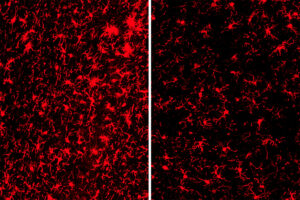
Immune cells are more activated (red) in the brains of mice with the gene TREM2 (left) than in those without the gene (right). A new study shows that having a working copy of the gene TREM2 can reduce risk of Alzheimer’s disease under certain conditions but worsen disease in others.

Scientists drilling down to the molecular roots of Alzheimer’s disease have encountered a good news/bad news scenario. A major player is a gene called TREM2, mutations of which can substantially raise a person’s risk of the disease. The bad news is that in the early stages of the disease, high-risk TREM2 variants can hobble the immune system’s ability to […]

Longer-lived imaging agents could hasten Alzheimer’s research

Mirica in his lab at Washington University in St. Louis. (Photo: Joe Angeles/Washington University)

In the past few years, despite the best efforts of scientists and medical researchers, drug after drug designed to slow or stop the progression of Alzheimer’s disease has failed in clinical trials. Some had no effect on the progression of the disease, others made patients’ symptoms worse and yet others produced results so equivocal it […]

Scientists Aim For Better, Cheaper Tests For Alzheimer’s (Links to an external site)

Finding some change in the blood of an Alzheimer's patient that accurately reflects the damaging changes in the brain has been tough. utah778//iStockphoto/Getty Images

Efforts to develop a treatment that stalls the memory-robbing devastation of Alzheimer’s disease have so far been unsuccessful, but scientists are making strides in another important area: the development of better tests to tell who has the condition. Their aim is to develop more accurate, cheaper and less invasive tests to detect the biological markers […]

Just one night of poor sleep can boost Alzheimer’s proteins (Links to an external site)

SLEEP DEEP Slow-wave sleep, the deepest stage of sleep, may keep the brain from accumulating proteins that can lead to Alzheimer’s. DNF-STYLE/ISTOCKPHOTO

How well, not how much, people sleep may affect Alzheimer’s disease risk. Healthy adults built up Alzheimer’s-associated proteins in their cerebral spinal fluid when prevented from getting slow-wave sleep, the deepest stage of sleep, researchers report July 10 in Brain. Just one night of deep-sleep disruption was enough to increase the amount of amyloid-beta, a protein that […]

How Seniors Are Driving Safer, Driving Longer (Links to an external site)

Americans love to drive. More than 75 percent of adults carry a driver’s license, including 40 million who are 65 and older. But driving is more than just a passion or a pastime: It’s a lifeline. Studies show that giving up driving increases a person’s mortality risk and makes seniors more likely to land in […]

Antibody Makes Alzheimer’s Protein Detectable in Blood (Links to an external site)

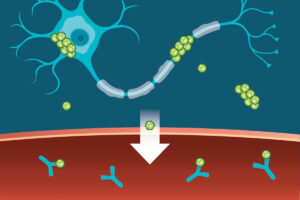
Caption: The protein tau (green) aggregates abnormally in a brain cell (blue). Tau spills out of the cell and enters the bloodstream (red). Research shows that antibodies (blue) can capture tau in the blood that reflect its levels in the brain. Credit: Sara Moser

Age can bring moments of forgetfulness. It can also bring concern that the forgetfulness might be a sign of early Alzheimer’s disease. For those who decide to have it checked out, doctors are likely to administer brief memory exams to assess the situation, and medical tests to search for causes of memory loss. Brain imaging […]