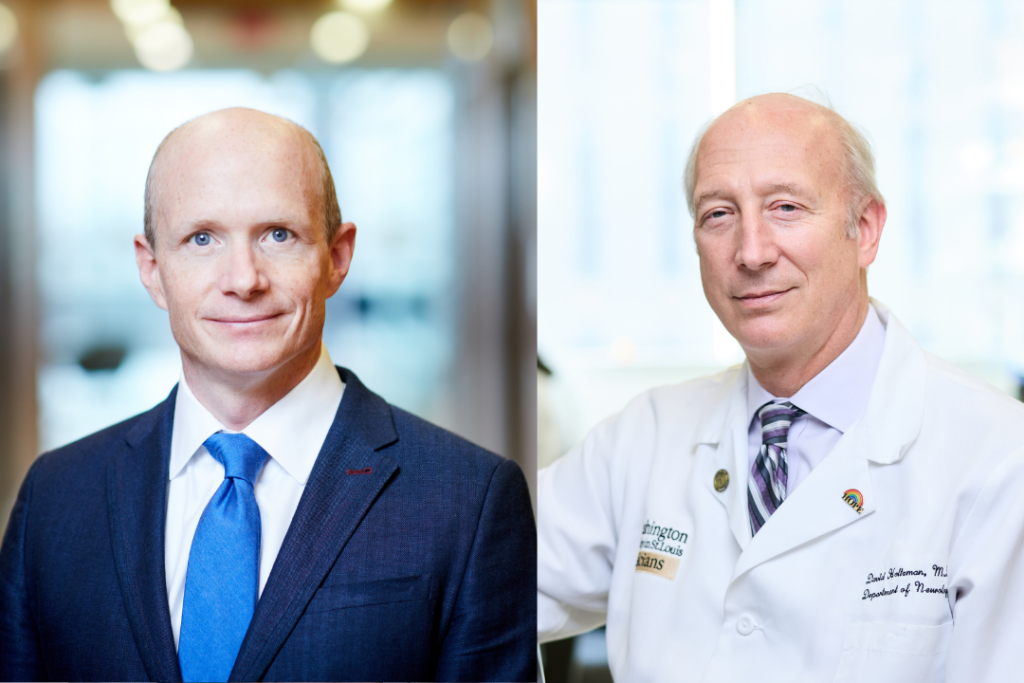
Randall J. Bateman, MD, the Charles F. & Joanne Knight Distinguished Professor of Neurology, and David M. Holtzman, MD, the Barbara Burton and Reuben M. Morriss III Distinguished Professor, have been selected as joint recipients of the 2026 WashU Medicine Dean’s Medal for Excellence in Innovation & Commercialization. This award recognizes WashU Medicine faculty members whose innovative research has been successfully translated into commercial applications, creating tangible benefits for patients and society. Bateman and Holtzman will be recognized during the WashU Medicine National Council meeting on October 28, for their field-transforming translational work in Alzheimer’s disease diagnosis and treatment.
“It is an honor to receive the Dean’s Medal for Excellence in Innovation and Commercialization with Dr. Bateman,” Holtzman said. “What is very rewarding was following the science for over 20 years and ultimately realizing that the initial underlying findings might ultimately lead to something that will help patients.”
Holtzman is a pioneer in the study of the pathogenesis, diagnosis and treatment of Alzheimer’s disease. From research on the fundamental genetic and molecular mechanisms behind Alzheimer’s disease to clinical trials for the prevention and treatment of neurodegeneration and commercialized cutting-edge diagnostic tools for Alzheimer’s disease, Holtzman’s work runs the entire gamut of Alzheimer’s disease research and has ushered the field into a new era of Alzheimer’s disease research in which scientists are attacking Alzheimer’s disease from all imaginable angles.
Bateman started with a basic question about amyloid-beta biology early in his career, when he was a member of Holtzman’s lab, and set out to answer if amyloid-beta plaques were caused by over-production or impaired clearance. Utilizing a stable isotope labeling kinetic (SILK) technique, Bateman determined that impaired clearance of amyloid is the main pathophysiology in late-onset Alzheimer’s.
Together, Bateman and Holtzman successfully demonstrated the effectiveness of SILK as a tool for testing the effectiveness of Alzheimer’s drugs, leading to commercial demand for SILK and the co-founding of C2N Diagnostics in 2007. The company was able to launch with paid pharmaceutical contracts already lined up and no need for substantial external investment, a rarity for start-ups. This enabled C2N to develop and grow with the long-term focus on providing blood-based diagnostics for Alzheimer’s patients. In 2020, the company developed and commercialized PrecivityAD, the first high-accuracy blood test for Alzheimer’s disease, which measures amyloid beta in blood in Alzheimer’s patients. The blood tests leverage mass spectrometry techniques developed by Bateman and antibodies developed in the Holtzman lab to allow researchers to better study metabolism of amyloid beta, tau, APOE and other proteins.
By developing blood tests for Alzheimer’s disease that are comparable to the accuracy of positron emission tomography (PET) and cerebrospinal fluid (CSF) tests in direct comparisons, Bateman and Holtzman’s collaboration has opened up a pathway to accurate Alzheimer’s disease diagnosis for millions of patients for whom PET or CSF tests are not viable options.
Outside of C2N, Bateman and Holtzman have shown remarkable success in leveraging their in-lab discoveries to launch a series of highly productive, high-profile research consortiums and partnerships with industry partners worldwide, including the Eisai/WashU research partnership, the DIAN-TU Pharma Consortium, the tau SILK Consortium and the NfL Consortium, which are joint academic and industry collaborations that have launched prevention trials, identified biomarkers useful for tracking and staging neurodegenerative disease and developed new treatments for Alzheimer’s disease, Parkinson’s disease and other neurodegenerative conditions. Most recently, Bateman led the establishment of the Consortium for Biomedical Research & AI in Neurodegeneration (C-BRAIN), together with pharmaceutical companies, AI tech companies and over 100 academic labs all over the world.
Bateman is a prolific innovator who holds 47 active or pending patents and is scientific co-founder and board member of C2N, as well as director of the Dominantly Inherited Alzheimer Network and the Tracy Family SILQ Center. Holtzman, who is also scientific co-founder and board member of C2N Diagnostics, holds 17 active or pending patents and serves as director of Hope Center for Neurological Disorders and Knight Alzheimer’s Disease Research Center at WashU Medicine. Bateman and Holtzman were also honored with the 2026 American Innovator Award from the Bayh-Dole Coalition for their work in Alzheimer’s diagnostics.