What if we can stop Alzheimer’s before it starts? (Links to an external site)
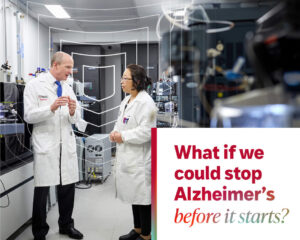
What if we could stop Alzheimer's before it starts?

Our focus is simple: stop Alzheimer’s before it starts. This disease steals the moments that make us who we are and the memories we share. That’s why we believe in attacking Alzheimer’s from every angle — because every breakthrough means more time, more hope and more moments together for families who can’t wait.

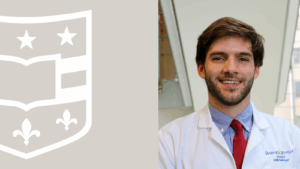
Resident Spotlight Brendan Whitelaw

Brendan Whitelaw

Brendan Whitelaw, MD, PhD, is a third year in the Adult Neurology Residency Program at Washington University School of Medicine in St. Louis. He is planning to specialize in vascular neurology and pursue a career as a physician scientist studying the molecular mechanisms driving cerebrovascular disease. Whitelaw went to college at the University of Pennsylvania, […]

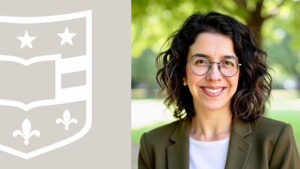
Faculty Profile Sarah Biber

Sarah Biber

Sarah Biber, PhD, is an interdisciplinary researcher whose work integrates data science, bioinformatics, human-centered systems engineering, and implementation science. From 2021 to 2025, she co-led the National Alzheimer’s Coordinating Center (NACC) as Executive Director and multi-Principal Investigator (mPI), guiding its transformation into a modern multimodal cloud-based platform that integrates longitudinal clinical, imaging, neuropathological, biomarker, genomic […]

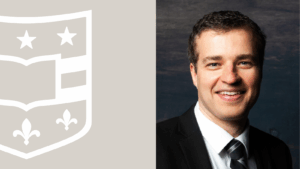
Faculty Profile Jan Kubanek (Links to an external site)

Jan Kubanek

Jan Kubanek, PhD, joined the faculty of WashU Medicine Department of Psychiatry on August 1, 2025, as associate professor of psychiatry in the Division of Clinical Neuroscience and Behavioral Health, with secondary appointments in the Department of Neurology and Department of Radiology.  He brings combined experience in human and macaque electrophysiology, human and macaque behavioral […]

Study: Huntington’s Disease could be slowed by 75% (Links to an external site)

DNA helix

Scientists may have reached a breakthrough in the fight against Huntington’s disease, a rare and fatal inherited brain disorder with no cure. For the first time, a gene therapy has been shown in clinical trials to significantly slow the progression of the disease, raising cautious optimism among researchers and families.

Congratulations to Neurology’s October 2025 SAFE accolade recipients

SAFE accolades - Neurology

Congratulations to the members of the Department of Neurology who received accolades through the Supporting a Fair Environment (SAFE) program! SAFE aims to improve the learning environment by promoting positive behaviors and managing concerns about learner mistreatment and unprofessional behaviors. SAFE accolades include treating others with dignity and respect, creating an environment that values diversity, […]

Weihl installed as Gabe Weil Professor

Chris Weihl

Conrad Weihl, MD, PhD, was installed as the Gabe Weil Professor on Tuesday, Sept. 23, 2025. The ceremony included remarks from David Perlmutter, MD, executive vice chancellor for medical affairs and the George and Carol Bauer Dean of Washington University School of Medicine in St. Louis, Chuck Rickert, MD, PhD, and Josephine and Richard Weil. […]