There’s Now a Rapid, Accurate COVID-19 Air Detector (Links to an external site)

fStop—Getty Images

The COVID-19 pandemic will forever be associated with unprecedented lockdowns and inconveniences such as wearing masks in public. And that’s largely because health experts had no idea exactly where the SARS-CoV-2 virus was lurking, and how risky crowded settings such as workplaces, classrooms, and public transportation were.

Restoring Hope: How a Breakthrough Treatment Helped a Teenager Defeat Epilepsy (Links to an external site)

Nearly a decade ago, St. Louis Children’s Hospital was one of the first to use an innovative procedure to cure pediatric epilepsy. As we celebrate 30 years as a system, we’re looking back at the groundbreaking innovations that cleared the way for the extraordinary care our patients—and everyone—deserves. Sophia Griffin, like most teenagers, just wanted […]

Staff Spotlight Ali Vonderheid

Ali Vonderheid

Born and raised in Florissant, Missouri, Ali Vonderheid played soccer, basketball, volleyball and softball throughout grade school, as well as nightly street hockey games with the neighborhood boys (yes, she was the only girl!). She continued playing soccer through high school and college where she attended Missouri Southern State University in Joplin (Vonderheid came back […]

Neurology Awards 2023 — So Far

Department of Neurology Awards - 2023

Several members of our department received distinguished service teaching awards from the medical school class of 2024, which just completed its clerkship. These individuals were selected from among the entire faculty, residents and staff of the medical school. On May 26, 2023, we held the Neurology Academic Symposium in which residents and fellows presented their […]

Air monitor can detect COVID-19 virus variants in about 5 minutes (Links to an external site)

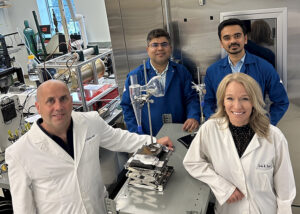
Clockwise from front left: Cirrito, Chakrabarty, Puthussery and Yuede stand alongside the SARS-CoV-2 wet cyclone aerosol sampler they developed. (Photo: Shubham Sharma)

Now that the emergency phase of the COVID-19 pandemic has ended, scientists are looking at ways to surveil indoor environments in real time for viruses. By combining recent advances in aerosol sampling technology and an ultrasensitive biosensing technique, researchers at Washington University in St. Louis have created a real-time monitor that can detect any of […]

ABC Science Collaborative, RADx-UP publish lessons learned about keeping children safe in school during COVID-19 pandemic (Links to an external site)

See what we learned about keeping schools safe during the COVID-19 pandemic.

The ABC Science Collaborative and RADx-UP have published a special supplement to the research journal Pediatrics focused on lessons learned while navigating the K-12 school environment during the pandemic. The publication supplement, “Navigating a Pandemic in the K-12 Setting, Part 2: COVID-19 Testing and Vaccination,” represents a collaborative effort between Pediatrics, The ABC Science Collaborative, and the RADx-UP […]

Diagnosis of rare, genetic muscle disease improved by new approach (Links to an external site)

Researchers at Washington University School of Medicine in St. Louis have developed an approach that could help doctors distinguish between the many subtypes of limb girdle muscular dystrophy, a rare, genetic muscle disease. With new therapies poised to enter the clinic, identifying the precise subtype is necessary to ensure that people get access to the treatment most likely to benefit them.

It’s not easy to distinguish between the dozens of subtypes of limb girdle muscular dystrophy — a rare, genetic muscle disease characterized by weakness in the hips and shoulders that causes difficulty walking and lifting the arms. Until now, determining the subtype has not been critical in caring for patients, because no specific treatments have […]

When Gut Bacteria May Be an Early Sign of Alzheimer’s Disease (Links to an external site)

Science Photo Library—Getty Images

When it comes to a disease as complex as Alzheimer’s, scientists have found a number of factors that can contribute to your risk, from genes to circulatory issues, inflammation, and lifestyle behaviors. In a new study published in Science Translational Medicine, researchers from Washington University in St. Louis report on another possible factor: the types of bacteria living […]

Altered gut bacteria may be early sign of Alzheimer’s disease (Links to an external site)

Alzheimer’s disease causes changes to the brain that begin two decades or more before symptoms appear. A study by researchers at Washington University School of Medicine in St. Louis reveals that the bacteria that live in the gut also change before Alzheimer’s symptoms arise, a discovery that could lead to diagnostics or treatments for Alzheimer’s disease that target the gut microbiome.

­People in the earliest stage of Alzheimer’s disease — after brain changes have begun but before cognitive symptoms become apparent — harbor an assortment of bacteria in their intestines that differs from the gut bacteria of healthy people, according to a study by researchers at Washington University School of Medicine in St. Louis.