Psilocybin generates psychedelic experience by disrupting brain network (Links to an external site)

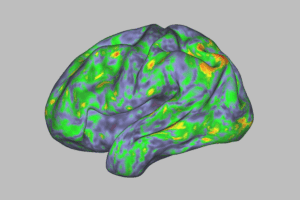
This heat map of brain activity patterns shows profound disturbance during an individual’s experience after taking psilocybin. Relatively stable patterns before and after the dose (blue and green hues) are temporarily scrambled during the "trip" (red, orange and yellow hues). Researchers at Washington University School of Medicine in St. Louis report that psilocybin destabilizes a critical network of brain areas involved in introspective thinking. The findings provide a neurobiological explanation for the drug’s mind-bending effects.

People who consume psilocybin-containing mushrooms — otherwise known as magic mushrooms — typically undergo a surreal experience in which their sense of space, time and self is distorted. Advocates have long argued that, under the right conditions, psychedelic experiences can alleviate mental distress, and a smattering of scientific studies suggests they may be right. Understanding […]

This Is Literally Your Brain on Drugs (Links to an external site)

This heat map of brain activity patterns shows profound disturbance during an individual’s experience after taking psilocybin. Relatively stable patterns before and after the dose (blue and green hues) are temporarily scrambled during the "trip" (red, orange and yellow hues). Researchers at Washington University School of Medicine in St. Louis report that psilocybin destabilizes a critical network of brain areas involved in introspective thinking. The findings provide a neurobiological explanation for the drug’s mind-bending effects.

The image, as it happens, comes from dozens of brain scans produced by researchers at Washington University School of Medicine in St. Louis who gave psilocybin, the compound in “magic mushrooms,” to participants in a study before sending them into a functional M.R.I. scanner.

Racial disparities in dementia determined by social factors (Links to an external site)

Merita (center) smiles at her great-granddaughter while her brother, Pablo, relaxes behind her. The family belongs to the Negritos community of Tumbes, a city in northern Peru. A study conducted in Peru and three other Latin American countries by researchers at Washington University School of Medicine in St. Louis reveals that racial disparities in brain health are due to social factors, with genetic ancestry playing no role.

Racial disparities in dementia are due to social determinants of health, with genetic ancestry playing no role, according to a new study led by researchers at Washington University School of Medicine in St. Louis. The study, which was based on a long-running population-based survey in four Latin American countries, helps explain why people of predominantly […]

Gurnett, Ssewamala to receive faculty achievement awards (Links to an external site)

Christina Gurnett

Christina Gurnett, MD, PhD, and Fred Ssewamala, PhD, have been chosen by their academic peers to receive Washington University in St. Louis’ 2024 faculty achievement awards, Chancellor Andrew D. Martin announced. Gurnett, the A. Ernest and Jane G. Stein Professor of Developmental Neurology at the School of Medicine, will receive the Carl and Gerty Cori Faculty […]

2023-24 Resident & Faculty Teaching Award Recipients

Irwin Levy Resident Teaching Award (outstanding teaching by a Neurology resident) Neurology Clerkship Student Teaching Award (faculty chosen by the students) Neurology Clerkship Student Resident Teaching Award Honor Roll Neurology Clerkship Student Faculty Teaching Award Honor Roll Sven Eliasson Award for Teaching Excellence (outstanding teaching by an adult Neurology attending) Adult Neurology Teaching Excellence Honor […]

Guerriero appointed Pediatric Epilepsy Section Head & Tomko steps in as SLCH EMU Medical Director

Guerriero & Tomko

Réjean “Rej” Guerriero, DO, has been appointed the section head for Pediatric Epilepsy, effective July 1, 2024. Concurrently, Stuart Tomko, MD, will become medical director of the St. Louis Children’s Hospital Epilepsy Monitoring Unit and Neurophysicology Laboratory, which is a National Association of Epilepsy Centers Level 4 (highest level) Pediatric Epilepsy Center. Guerriero will direct […]

Study aims to understand genetics of Parkinson’s disease in Black people  (Links to an external site)

Erin Foster, an associate professor of occupational therapy, and Scott Norris, MD, an associate professor of neurology, have established a site at Washington University School of Medicine in St. Louis for the Black and African American Connections to Parkinson’s Disease (BLAAC PD) study, an international study aimed at understanding the gene changes that may lead to […]