For accuracy, brain studies of complex behavior require thousands of people (Links to an external site)

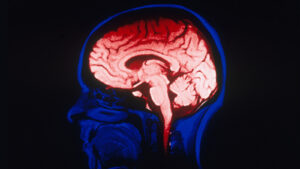
Scientists rely on brainwide association studies to measure brain structure and function — using brain scans — and link them to mental illness and other complex behaviors. But a study by researchers at Washington University School of Medicine in St. Louis and the University of Minnesota shows that most published brainwide association studies are performed with too few participants to yield reliable findings.

As brain scans have become more detailed and informative in recent decades, neuroimaging has seemed to promise a way for doctors and scientists to “see” what’s going wrong inside the brains of people with mental illnesses or neurological conditions. Such imaging has revealed correlations between brain anatomy or function and illness, suggesting potential new ways […]

Risk, resiliency in aging brain focus of $33 million grant (Links to an external site)

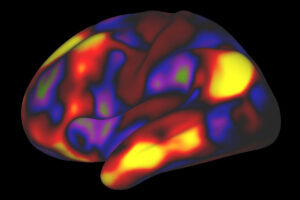
A functional MRI scan reveals the default mode network in the brain of a person at rest (above). Researchers with the Adult Aging Brain Connectome Study are collecting these and similar brain scans from 1,000 adults to study risk and resilience in the aging brain. The project, which involves researchers at Washington University School of Medicine in St. Louis and other institutions, is funded by a $33.1 million grant from the National Institute on Aging.

A large study that investigates just what keeps our brains sharp as we age and what contributes to cognitive decline has been launched by researchers from Washington University School of Medicine in St. Louis, Harvard University/Massachusetts General Hospital, the University of Minnesota Medical School and the University of California Los Angeles (UCLA).

New Alzheimer’s prevention trial in young people (Links to an external site)

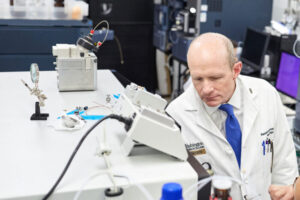
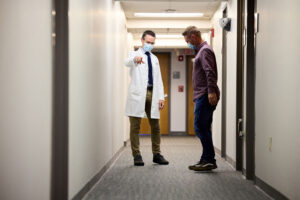
Neurologist Eric McDade, DO, meets with Marty Reiswig, a participant in Alzheimer’s prevention trials at Washington University School of Medicine in St. Louis. Reiswig comes from a family with a genetic mutation that puts carriers at high risk of developing Alzheimer’s. McDade is the director of a new Alzheimer’s prevention trial involving young adults from high-risk families. The trial is evaluating whether an investigational drug can clear a key Alzheimer’s protein called amyloid beta and slow or stop the disease. (Photo: Matt Miller/School of Medicine)

Washington University School of Medicine in St. Louis is launching an international clinical trial aimed at preventing Alzheimer’s disease in people genetically destined to develop the illness at a young age. Unlike most other Alzheimer’s prevention trials, this one will enroll people before the disease has taken hold — up to 25 years before the […]