YOUR HEALTH: Fasting could have an impact on diseases, including MS (Links to an external site)

Amy Thomas on computer at hospital

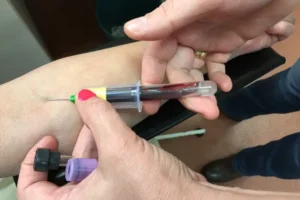
ST. LOUIS, Missouri – Amy Thomas was diagnosed with Multiple Sclerosis 13 years ago. “It’s just another component of my life to manage. It’s not defining who I am.” She regularly gets blood drawn to measure the benefits of intermittent fasting. In a study measuring the benefits of intermittent fasting, she eats non-starchy vegetables two days a week.  […]

Many Faces of Neurofibromatosis (Links to an external site)

Portraits of people with neurofibromatosis, a genetic disease that causes tumors, line the hallways of the Farrell Learning and Teaching Center on the Medical Campus as part of an art installation by Rachel Mindrup titled "Many Faces of NF."

Large, glossy oil paintings of people enjoying the small pleasures of everyday life – reading, practicing martial arts, scooping ice cream – line the hallways in the Farrell Learning and Teaching Center at Washington University School of Medicine in St. Louis. Upon close inspection, some of the features of the people in the portraits are […]

Before it begins (Links to an external site)

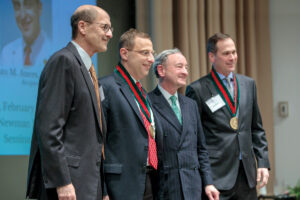
Beau Ances, MD, PhD, MSc, second from left, becomes an endowed professor. Joining in on the celebration are (from left): David H. Perlmutter, MD, executive vice chancellor for medical affairs and dean of the School of Medicine; Chancellor Mark S. Wrighton; and Daniel J. Brennan II.

Abequest by the late Daniel J. Brennan, MD, is supporting significant advancements in Alzheimer’s disease research at the School of Medicine. The disease affects 5.5 million Americans — a number expected to climb rapidly as people live longer. Following Brennan’s death in 2010, the estate gift created the Daniel J. Brennan, MD, Research Fund in […]

Blood test detects Alzheimer’s plaques building up in brain (Links to an external site)

Early screening Deyan Georgiev / EyeEm / Getty

A blood test can detect whether plaques of beta-amyloid are building up in a person’s brain – a sign that they may develop Alzheimer’s disease. People with Alzheimer’s disease tend to have sticky clumps of beta-amyloid in their brains, although the part these plaques play in the condition is unclear. Until now, the only way […]

Blood test IDs key Alzheimer’s marker (Links to an external site)

A study led by researchers at Washington University School of Medicine in St. Louis suggests that measures of amyloid beta in the blood have the potential to help identify people with altered levels of amyloid beta in their brains or cerebrospinal fluid. Ideally, a blood-based screening test would identify people who have started down the path toward Alzheimer’s years before they could be diagnosed based on symptoms. (Getty Images)

Decades before people with Alzheimer’s disease develop memory loss and confusion, their brains become dotted with plaques made of a sticky protein – called amyloid beta – that is thought to contribute to the disease and its progression. Currently, the only way to detect amyloid beta in the brain is via PET scanning, which is […]

Stop Alzheimer’s before it starts (Links to an external site)

In 2015, the global cost of Alzheimer’s disease was US$818 billion. That’s similar to the gross domestic product of the world’s 18th-largest economy. By 2030, the number of people with the disease is expected to rise to more than 70 million worldwide (see ‘Staying ahead’).

At Age 8, DIAN Is Churning Out Data and Growing into a Movement

One February 25, 2015, Lori DeMoe McIntyre died of Alzheimer’s disease at age 56, after participating in DIAN research for nearly eight years. Her daughter Jessica McIntyre memorialized her mom with a large tattoo of Lori’s amyloid PIB PET scan. The younger McIntyre and one of her sisters participate in DIAN and DIAN-TU. [Courtesy of Jessica McIntyre, art by Joey Borger, Certified Customs, Denver, Colorado.]

Part 1 of a five-part series. At age 8, DIAN has grown up. In 2008, when the Dominantly Inherited Alzheimer’s Network formally began to study autosomal-dominant AD, the notion of assembling globally dispersed families afflicted with this rare form of AD into a standing research platform seemed radical to observers. In theory, the idea of […]

An Army Buddy’s Call For Help Sends A Scientist On A Brain Injury Quest

When Chris Moroski was hurt in 2005, “head injuries weren’t really a thing,” he recalls. “No one really considered why I was vomiting all the time. No one considered that it was probably from a concussion.” Ellen Webber for NPR

Katherine Du/NPRThe first time Kit Parker’s phone rang, everything seemed fine. It was January 2006, and Parker’s old Army buddy Chris Moroski was calling to say hi. Parker and Moroski had jumped out of airplanes together in the 1990s when they were paratroopers in the National Guard. But after the attacks on Sept. 11, Parker […]