Podcast: Pandemic contributing to uptick of mental health problems in kids (Links to an external site)

Although children tend to be at lower risk of COVID-19, the number of kids with mental health and behavioral problems has exploded during the pandemic, driving an increase in pediatric hospital admissions nationwide. In this episode of "Show Me the Science," child psychiatrist John Constantino, MD, and pediatric neurologist Christina Gurnett, MD, PhD, discuss some of Washington University's efforts to reverse that trend.

Infections with the virus that causes COVID-19 are not the only cause of pandemic-related hospitalizations. Although children tend to be at lower risk of COVID-19, the number of kids with mental health and behavioral problems has exploded during the pandemic, driving an increase in pediatric hospital admissions nationwide. Stressors associated with remote schooling, fear of […]

Rainwater Charitable Foundation Announces Second-Annual Rainwater Prize Winners for Brain Research (Links to an external site)

FORT WORTH, Texas, Feb. 22, 2021 /PRNewswire/ — The Rainwater Charitable Foundation, one of the largest independent funders of neurodegenerative disease research, today announced Dr. David M. Holtzman (the Andrew B. and Gretchen P. Jones Professor and Chair of Neurology, Washington University School of Medicine in St. Louis) and Dr. Celeste Karch (Associate Professor of Psychiatry, […]

Construction progresses on neuroscience research building (Links to an external site)

The neuroscience research building’s basement lies in a hole 25 feet deep and 400 feet long, dug at the southeast corner of Duncan and Newstead avenues. More than 106 drilled concrete piers have been poured, and the interior columns and floor in the western half of the basement have been completed. (Photo: Matt Miller/School of Medicine)

Washington University School of Medicine’s eastern border began noticeably changing in April and will look strikingly different in 2023, when the neuroscience research building — 11 stories tall and 609,000 square feet — is complete. The building project, the largest in the medical school’s history, will span almost a block in the 200-acre Cortex Innovation […]

Why doesn’t deep-brain stimulation work for everyone? (Links to an external site)

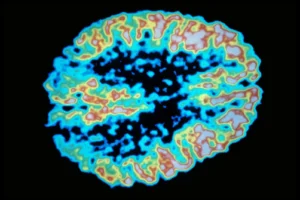
Brain networks corresponding to functions such as vision (blue) and attention (green) mingle and share information in structures deep inside the brain, as seen, for example, in the bottom right corner of this color-coded composite MRI image. Researchers at Washington University School of Medicine in St. Louis have mapped nine functional networks in the deep-brain structures of 10 healthy people, an accomplishment that could lead to improvements in deep-brain stimulation therapy for severe cases of Parkinson’s disease and other neurological conditions. (Image: Scott Marek)

People with severe Parkinson’s disease or other neurological conditions that cause intractable symptoms such as uncontrollable shaking, muscle spasms, seizures, obsessive thoughts and compulsive behaviors are sometimes treated with electric stimulators placed inside the brain. Such stimulators are designed to interrupt aberrant signaling that causes the debilitating symptoms. The therapy, deep-brain stimulation, can provide relief […]

Genes linked to Alzheimer’s risk, resilience ID’d (Links to an external site)

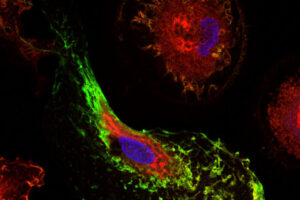
A team led by researchers at Washington University School of Medicine in St. Louis has identified a pair of genes that influence risk for Alzheimer’s disease. The genes — known as MS4A4A and TREM2 — affect the brain’s immune cells. They influence Alzheimer’s risk by altering levels of TREM2, a protein (shown stained in red) that is believed to help microglia cells clear excessive amounts of the Alzheimer’s proteins amyloid and tau from the brain. The MS4A4A protein is shown stained in green. (Image: Fabia Filipello and Dennis Oakley)

An international team of researchers led by scientists at Washington University School of Medicine in St. Louis has identified a pair of genes that influence risk for both late-onset and early-onset Alzheimer’s disease. Most genes implicated thus far in Alzheimer’s affect neurons that transmit messages, allowing different regions of the brain to communicate with one […]

Biogen, Alkermes MS drug bests Biogen’s soon-to-be-generic blockbuster in Phase III study (Links to an external site)

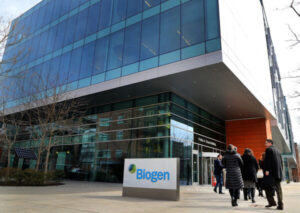
Biogen Headquarters In Cambridge

A drug under consideration by the Food and Drug Administration for multiple sclerosis has shown superiority in terms of gastrointestinal tolerability over its comparator. But while analysts said the drug will likely win FDA approval, it is uncertain if the latest data will drive significant uptake, especially with the comparator’s anticipated availability as a generic.